
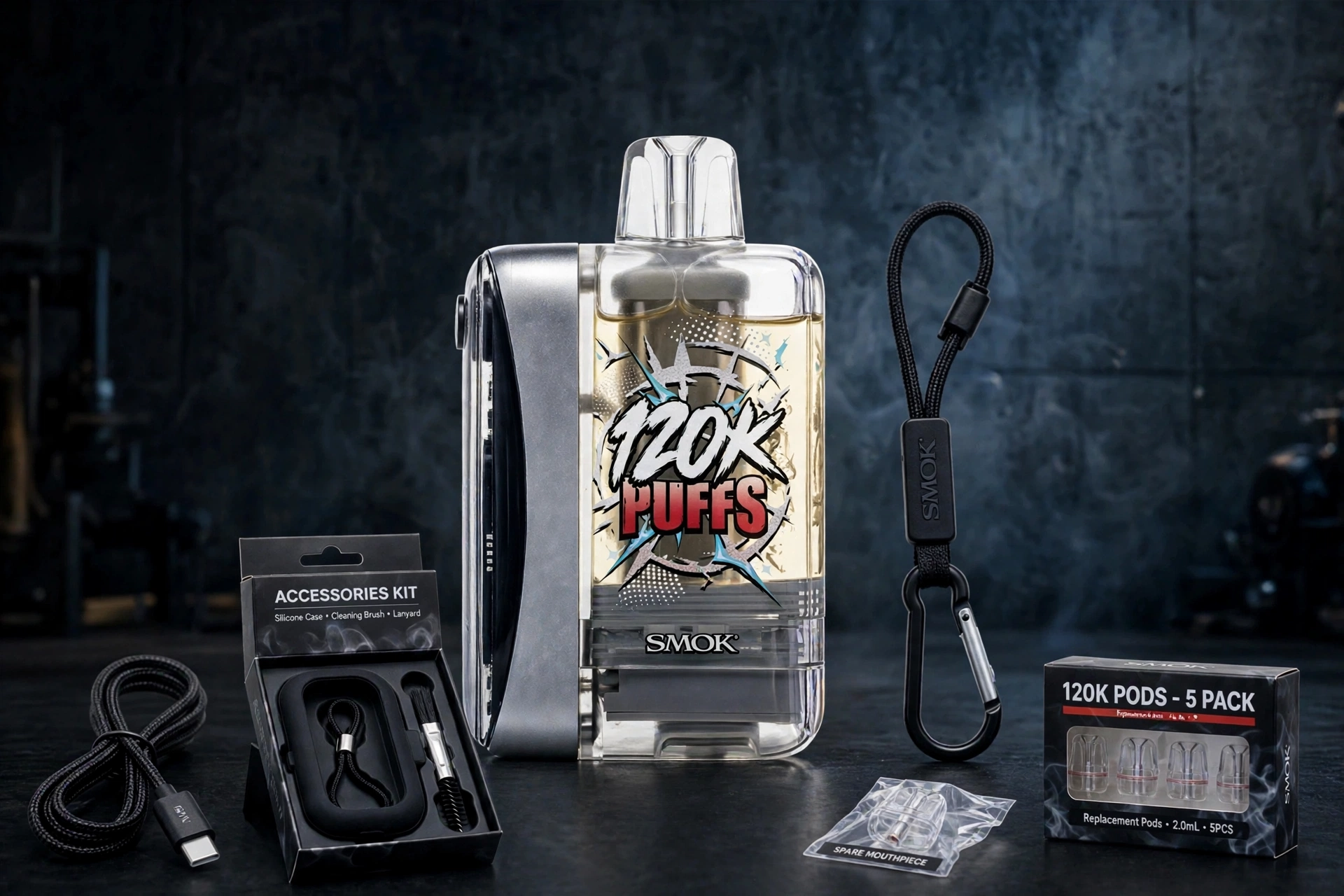
The device is sold on one headline number: up to 120,000 puffs. That number is the only specification that could be confirmed from the listings checked for this guide. Battery size, e-liquid volume, nicotine strength, coil type, power modes, screen type, and airflow design were not confirmed for this exact variant in those listings, and this guide does not invent them.
That gap matters, because other brands also sell a 120K device, and their numbers do not belong to SMOK. The OKSO 120K, the Spin 120K, and other 120K disposables have their own batteries, tanks, and modes. Copying their figures into this guide would mislead readers and send them looking for a screen, a mode, or a tank their own device may not have.
So this guide works differently from the earlier guides in the series. It treats the device as a high-capacity disposable vape kit, gives you the checks that work on any variant, and tells you at each step to confirm the detail on your own box and device: whether it is rechargeable, whether it has a screen or a light indicator, whether it has power modes, whether airflow is adjustable or fixed, and what nicotine strength your label shows. If your variant does not have a feature, skip that check. Do not hunt for a button or a screen that is not there.
The ten problems below run in a mixed order: not charging and flavor fading first, then not firing, weak vapor, burnt taste, leaking, battery drain, flashing and screen trouble, draw and airflow feel, and auto-firing last. Each section lists likely reasons, steps to try, and the point where replacement is the honest answer, so a flat battery is not mistaken for a dead device, and a finished device is not kept on hope after 120,000 advertised puffs.
Stop and read this first: This product is for adults aged 21 and over in the US. Do not open the device, do not try to refill it unless your own kit instructions say it is refillable, do not try to replace a coil on your own, and do not repair a battery. When the checks in this guide fail, replacement is the next step, not a home repair. Do not charge a device that feels hot, looks swollen or cracked, leaks heavily, or smells of burning plastic.
Jump to Section
SMOK 120K at a Glance: A 120,000-Puff Claim With Unconfirmed Details
Power Modes, Screens, and Airflow: What to Check on Your Own Variant
SMOK 120K Problems in One Quick Look
Fixing the SMOK 120K, One Problem at a Time
SMOK 120K at a Glance: A 120,000-Puff Claim With Unconfirmed Details
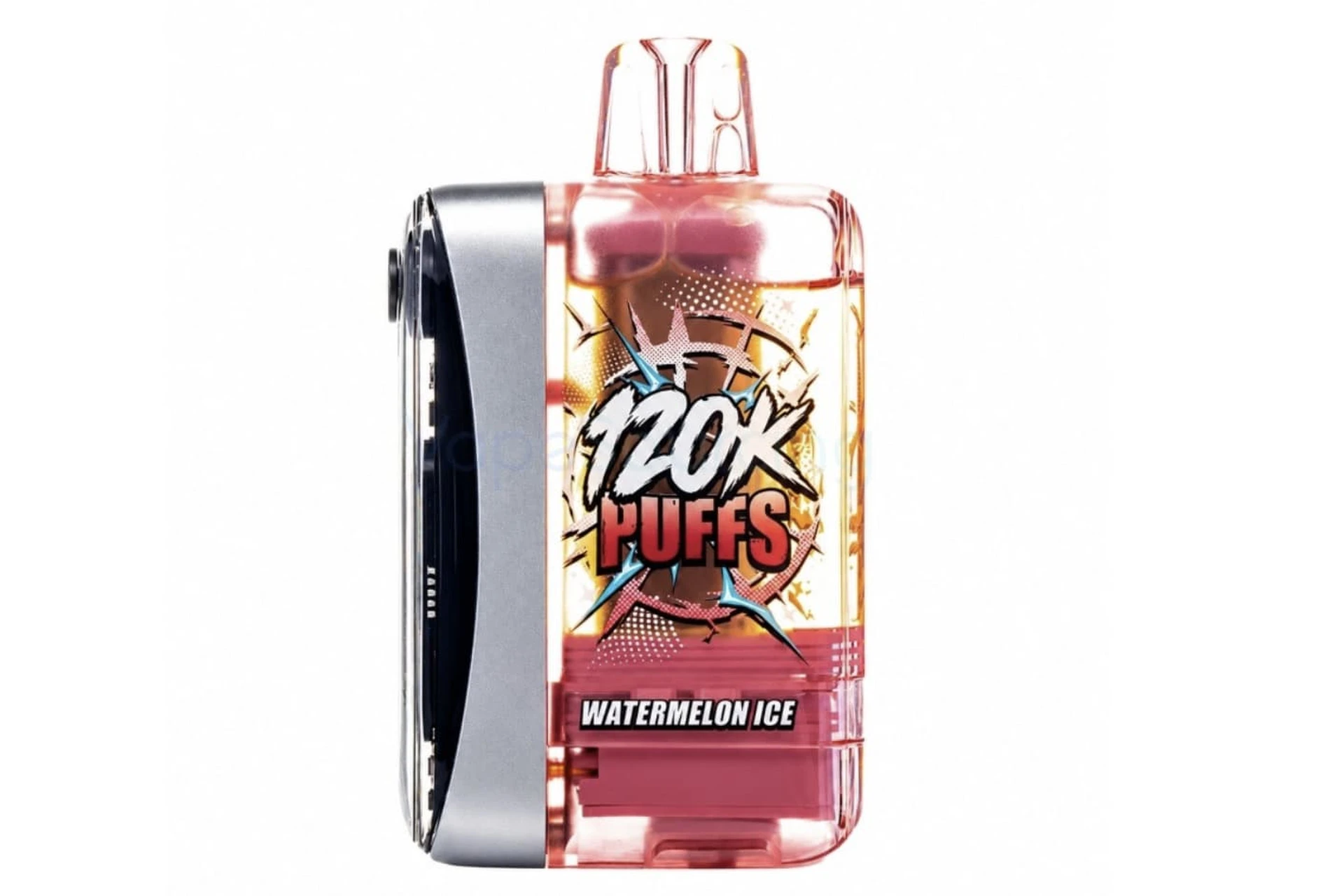
| Entity / feature | What it is on the SMOK 120K |
|---|---|
| Brand | SMOK |
| Product line | SMOK 120K |
| Device type | Disposable vape kit, per the listings checked; check your own box to confirm whether your variant is sealed or modular |
| Puff rating | Up to 120,000 puffs, advertised; a maximum under test conditions, not a promise for every user |
| E-liquid | Not confirmed for this exact SMOK variant in the listings checked; check the volume on your own box, and whether it refers to a total or to separate chambers |
| Battery | Not confirmed for this exact SMOK variant in the listings checked; check your own box for capacity and whether the device is rechargeable |
| Charging | Not confirmed for this exact SMOK variant in the listings checked; check your own box for the port type and follow the maker instructions |
| Coil | Not confirmed for this exact SMOK variant in the listings checked; do not assume a mesh coil, a resistance figure, or a coil count from another brand |
| Display | Not confirmed for this exact SMOK variant in the listings checked; check whether your device shows battery or e-liquid status on a screen or a light indicator |
| Modes | Not confirmed for this exact SMOK variant in the listings checked; check your own box for power modes, if any |
| Airflow | Not confirmed for this exact SMOK variant in the listings checked; some high-capacity devices use adjustable airflow, others use a fixed draw |
| Nicotine | Not confirmed for this exact SMOK variant in the listings checked; check the strength on your own label and follow local rules |
| Safety | Do not use a device that is hot, swollen, cracked, or leaking heavily |
A puff rating is a ceiling set under test conditions, not a personal lifespan. Longer pulls, frequent sessions, and higher power all pull the real count down from the advertised figure. The rating also says nothing about one charge, since a high-capacity device can still need frequent charging if it is used hard.
Note on other 120K devices: do not apply OKSO 120K figures (850mAh, 60mL in three chambers, triple mesh), Spin 120K figures (30mL, Eco and Turbo modes, adjustable airflow), or any other 120K brand figures to the device. Those are different products, and this guide deliberately leaves the device battery, liquid, coil, mode, screen, and nicotine figures blank where the SMOK listings checked did not confirm them.
Note on charging time: no consistent full-charge time was found for this exact variant, so this guide gives no minute count. Charge until your own device shows full, whether that is a screen reading or a light indicator, and do not judge a charge by the clock alone.
Power Modes, Screens, and Airflow: What to Check on Your Own Variant
Before blaming a fault, check what your own variant actually has. On a device, the battery state, liquid state, power setting, screen or indicator reading, and airflow design explain most complaints, but only the features your device carries can be checked. A missing feature is not a fault.
If Your Variant Has Power Modes
Some high-capacity disposables offer a lower-power mode for longer life and a higher-power mode for thicker vapor and stronger flavor. If your device has modes, the lower-power mode is the setting for baseline testing: it uses liquid and charge more slowly, gives a cooler draw, and shows whether a problem was mode-related. A higher-power mode uses liquid faster, drains charge faster, and can turn a low-liquid device burnt sooner. If your variant has no mode control, skip this check entirely and test on the single setting the device gives you. Mode, where it exists, usually stays set after charging until you change it again.
If Your Variant Has a Screen or Indicator
Some high-capacity disposables show battery and liquid on a screen, others show only a light, and others show neither in detail. If your device has a screen, read it during a pull, not only at rest, and note battery, mode, and liquid if shown. If it has only a light, learn what your light means from your own box: a steady light, a flashing light, and no light mean different things on different devices. A screen or light showing low charge, a mode that will not change, an empty liquid reading, or nothing at all after a full charge points to a real issue. A screen or light that looks normal while the device tastes burnt still points to a finished device, since a reading cannot create liquid that is gone.
Airflow works the same way. Some devices let you adjust airflow, others fix the draw at the factory. If yours is adjustable, the middle setting is the baseline for testing. If yours is fixed, do not look for a slider that is not there, and judge draw problems by mouthpiece, inlets, charge, and liquid instead.
SMOK 120K Problems in One Quick Look
| Problem | First thing to check |
|---|---|
| Not charging | Cable, adapter, port, screen or light charging sign, damage, whether your variant is rechargeable |
| Flavor fading / flat taste | Liquid left, device age, power mode if fitted, palate fatigue |
| Not firing / not hitting | Cap, charge, liquid left, draw strength, screen or light reading, damage |
| Weak vapor | Charge, liquid left, power mode if fitted, airflow if adjustable, pauses between draws |
| Burnt taste | Liquid left, power mode if fitted, chain puffing, device age |
| Leaking / gurgling / spitback | Mouthpiece condensation, draw strength, heat, damage, device age |
| Fast battery drain | Power mode if fitted, draw length, charging habits, device age |
| Flashing / screen errors | Charge, mode if fitted, liquid reading, damage |
| Draw feels different / airflow | Airflow setting if adjustable, blocked inlets, condensation, charge |
| Auto-firing / getting hot | Stop using it immediately, do not charge or reuse it |
Fixing the SMOK 120K, One Problem at a Time
A device can stop hitting, fail to charge, leak, flash, or taste burnt when the battery, liquid, coil, power setting, airflow, or screen or indicator has a problem. The checks below help pin down which one before spending money on a replacement, without assuming a feature your variant may not have.
Basic check, do this first for any problem below, unless that section tells you to stop for safety: Remove any mouthpiece cap or plug from a new device. If your variant is rechargeable, charge it fully, until your screen or light shows full. If your variant has power modes, set it to the lowest-power mode for testing. If airflow is adjustable on your variant, set it to the middle. Check the liquid level by any window, screen, or indicator your device has, and wipe the mouthpiece with a dry tissue. Take a firm, steady pull and leave pauses between pulls. If liquid is finished, or the taste is burnt after a full charge, that device is finished, even if the advertised puff count has not been reached.
This SMOK 120K is sold on one headline number, and its checks depend on which variant you own. The HorizonTech 100K is the closest cousin on this site: a sealed disposable with a big tank, two power modes and a side screen, where the puff rating also splits by mode. If your device is a HorizonTech, not a SMOK, start with our HorizonTech 100K Not Working guide, which covers the same mode, screen and charging checks for that big-tank bar.
1. Why Is the SMOK 120K Not Charging?
No charging on a device usually means the cable, adapter, port, or battery is at fault, not the puff rating. A screen or light should show a charging sign on a healthy rechargeable device, so a screen or light staying dark while plugged in is itself a clue.
Common Causes
- A loose, damaged, or low-power USB cable that cannot deliver a full charge, if your variant charges by cable.
- A weak adapter, such as a low-power computer port, charging very slowly.
- Lint or residue in the charging port, blocking the connection.
- A device that is too hot or too cold to take a charge safely.
- A battery at the end of its life, refusing to hold a charge.
- Port damage from a drop, or from forcing a cable in at an angle.
- A variant that is not rechargeable at all, in which case no cable will revive it, and the device is finished when the battery dies.
How to Fix
- Do the basic check first, except for the full charge step, which is the problem here.
- Confirm from your own box whether your variant is rechargeable. If it is not, stop here: a non-rechargeable device with a dead battery is finished, not broken.
- Try a cable and wall adapter you know are good. Test that cable and adapter on another device if you can, so you know they work.
- Check the port for lint or residue and clear it gently with a dry, soft brush. Do not use metal tools inside the port, and do not force the cable.
- Plug the device in and watch for a charging sign on the screen or light. Test first without pulling, so you can see whether the charge level rises.
- Bring the device to room temperature and charge it upright. A device that is very hot or very cold may refuse a charge until it returns to a normal temperature.
- Charge for a full cycle, until your screen or light shows full, and check the reading again. A charge level that does not rise at all points to the port or battery.
When to Replace
Replace the device if it refuses to charge on a known good cable and adapter, after clearing the port, at room temperature, for a full charge cycle, or if the port is cracked or loose, or if your variant is not rechargeable and the battery is dead. A sealed device with a dead battery or port is not a home repair.
2. Why Does the SMOK 120K Flavor Fade or Taste Flat?
Fading flavor on a device usually means liquid is running low, the device has been used hard, the coil is aging, or your palate is tired, rather than a change in the flavor itself. A coil can only turn liquid into vapor; it cannot create flavor from a device close to empty.
Common Causes
- A low liquid level, so each pull carries less flavor.
- Long time in a higher-power mode, if fitted, using liquid faster and wearing the coil faster.
- Back-to-back pulling, heating the coil and dulling flavor for a short while.
- Palate tiredness from the same flavor all day, making a normal hit taste flat.
- Warm storage, shifting how the flavor tastes.
- An aging device close to the end of its advertised life, with a coil that no longer performs as it did at the start.
How to Fix
- Do the basic check first.
- Drop to the lowest-power mode, if your variant has modes, and take a few short pulls with pauses. A gentler mode and a rest show whether the fade came from heat or power, rather than a finished device.
- Check liquid by any window, screen, or indicator your device has, not just the puff count. A high puff count does not mean liquid remains, since higher power uses liquid faster. A device close to empty on liquid is finished.
- Drink water and step away from the flavor for a short while. Palate tiredness is common with one flavor all day, and a break often brings the taste back.
- Keep the device cool and upright. Warmth can dull flavor and push liquid into the airway, which also dulls the taste.
- Compare against a fresh device, if you have one. A fresh device tasting strong while the old device tastes flat, on the same power setting and airflow, shows the old device is at the end of its life.
When to Replace
Replace the device if flavor stays flat after a full charge, a lowest-power test, pauses between pulls, and a cool upright rest, or if liquid is finished. Do not keep using a device that tastes flat and burnt, since that signals a finished supply.
3. Why Is the SMOK 120K Not Firing or Not Hitting?
Not firing, or not hitting, on a device often means the device is flat, finished, still capped, or damaged, rather than a broken button, since many disposables fire on draw alone. Start with cap, charge, and liquid, since those checks settle most no-hit cases in seconds.
Common Causes
- A mouthpiece cap or plug still in place on a new device, blocking the pull.
- A flat battery, with no power left for the coil.
- A finished device, with nothing left to turn into vapor.
- A very gentle pull that fails to trigger the draw sensor.
- An airflow setting closed too far, if airflow is adjustable on your variant, choking the draw sensor.
- Condensation in the mouthpiece, weakening the draw signal.
- Damage from a drop, breaking the sensor or coil even when the body looks fine.
How to Fix
- Do the basic check first.
- Pull off any cap or plug from the mouthpiece and check the airway. A new device can seem dead while the plug is still in place.
- Take a firm, steady pull lasting 2 to 3 seconds, with airflow in the middle if adjustable. A short, light puff may fail to trigger the sensor. Do not pull as hard as you can, which drags liquid into the airway.
- Wipe the mouthpiece and check the inlets for lint or residue. Do not push metal tools inside the device.
- Charge the device fully, if rechargeable, then test again on the lowest-power mode if fitted. If it still will not hit with a full battery, liquid remaining, an open airflow setting where fitted, and a firm pull, the sensor or coil is the likely cause.
- Check the screen or light, if fitted, during a pull. A screen or light that stays dark after a full charge points to battery or sensor trouble, not a setting.
When to Replace
Replace the device if it still will not hit after the basic check, cap removal, a firm pull with airflow in the middle where adjustable, a wiped mouthpiece, and a full charge where rechargeable, or if liquid is finished. A sealed device with a dead sensor or coil is not a home repair.
4. Why Is the Vapor Weak on the SMOK 120K?
Thin vapor on a device often means charge, liquid, power, or airflow is working against you, rather than a dead coil. Start with charge and liquid, since those two settle most thin-hit cases before any other guess.
Common Causes
- A low battery, giving thin vapor even while liquid remains.
- A higher-power expectation, where a lower-power mode, if fitted, feels thin by comparison.
- An airflow setting set too tight, if adjustable, choking the pull and making vapor feel weak.
- Pulls taken one after another, with no recovery time for the coil.
- Blocked inlets or condensation in the mouthpiece, weakening the draw signal.
- A low liquid level, leaving the coil less to turn into vapor on each pull.
- An aging device, with a coil that no longer performs as it did when new.
How to Fix
- Do the basic check first.
- Try one pull in a higher-power mode, if your variant has modes, for comparison. If vapor jumps sharply, the lower-power mode was the explanation, not a fault. Return to the lowest-power mode for everyday use if you want the device to last.
- Set airflow to the middle, if adjustable, then open it a step. A setting closed too far can make a normal hit feel weak. Open it gradually until the pull feels natural. If airflow is fixed on your variant, skip this step.
- Keep pulls shorter and steadier, with gaps between them. Long, hard pulls drain power and dry the coil. Short pulls with pauses give steadier vapor.
- Wipe the mouthpiece gently and check the inlets for lint or residue. Do not push metal tools inside the device.
- Charge the device fully, if rechargeable, then test again. Thin vapor that survives a full charge, liquid remaining, a middle airflow setting where adjustable, and a higher-power comparison points to the coil itself.
When to Replace
Replace the device if vapor stays thin after the basic check, a higher-power comparison where fitted, opening the airflow where adjustable, pauses between pulls, a wiped mouthpiece, and a full charge where rechargeable, or if liquid is finished. A device with worn coils is not a home repair.
5. Why Does the SMOK 120K Taste Burnt?
A burnt taste on a device usually means liquid is finished, the coil has dried out, power is too high for the liquid left, or pulls are coming too fast for the coil to stay wet. Treat a burnt taste as a stop sign, not a setting to push past, even on a device with a large advertised puff count.
Common Causes
- A liquid level close to empty, so the coil heats with little liquid left, even after weeks of use.
- Back-to-back pulling, drying the coil between pulls.
- A higher-power mode, if fitted, on a device already low on liquid, heating the coil harder.
- Warm storage, drying the coil and shifting the taste.
- An aging device close to the end of its advertised life, with a worn coil.
How to Fix
- Do the basic check first.
- Drop to the lowest-power mode, if fitted, and take one short pull after a pause. If the burnt taste softens on low power, power was too high for the liquid left. If it stays burnt on low power, the device is likely finished.
- Check liquid before any other test, by any window, screen, or indicator your device has. A device close to empty on liquid is finished, even with a full battery.
- Leave at least 30 seconds between pulls. That gap lets the coil stay wet. Do not chain-pull a device that already tastes burnt.
- Rest the device upright somewhere cool for a short while. Warmth worsens a burnt taste, and a rest shows whether heat was part of it.
- Do not try to refill the device or add liquid to the mouthpiece, unless your own kit instructions say it is refillable. A sealed device will not be rescued by added liquid.
When to Replace
Replace the device if the burnt taste hangs on after a lowest-power test, pauses between pulls, a cool rest, and a full charge where rechargeable, or if liquid is finished. A burnt taste that will not clear means a finished device, not a setting problem.
6. Why Is the SMOK 120K Leaking or Gurgling?
Leaking on a device usually means condensation in the mouthpiece, a hard pull dragging liquid upward, warmth thinning the liquid, or a damaged device, rather than a refill problem. A little condensation after many pulls is normal, and it needs a different response from a steady, heavy leak.
Common Causes
- Condensation gathering in the mouthpiece after repeated pulls, then gurgling or spitting tiny drops.
- Fast, hard pulls dragging liquid into the airway instead of vapor.
- Warmth from a pocket, car, or sun making the liquid thinner and pushing it toward the mouthpiece.
- Long storage upside down or on its side, letting liquid settle in the airway.
- A cracked body or split mouthpiece letting liquid out.
- A device close to the end of its life, with a coil that no longer turns liquid to vapor cleanly.
How to Fix
- Do the basic check first.
- Wipe the mouthpiece with a dry tissue and tip it gently downward, away from your face. That clears condensation without opening the device. Do not blow hard through the mouthpiece, and do not push metal tools inside it.
- Shorten pulls and keep them steady. Long, hard pulls drag liquid upward. Short pulls with gaps between them let the coil turn liquid to vapor evenly.
- Test on the lowest-power mode, if fitted, with airflow in the middle where adjustable. A gentler mode and a middle setting pull less hard on the liquid and show whether the leak was tied to how you were pulling.
- Keep the device cool and upright. Warmth and sideways storage both make leaks worse, so keep it away from sun and hot cars.
- Look over the body and mouthpiece for cracks or splits. A crack is not condensation. See the replacement note below.
When to Replace
Replace the device if leaking carries on after the basic check, a wiped mouthpiece, shorter pulls, a lowest-power test, and cool upright storage, or if liquid pools, the body cracks, or the mouthpiece splits. A heavily leaking device should not be charged or used further.
Most of the problems in this guide are about the device, but the liquid inside it is worth knowing about too. Vaping is less harmful than smoking, but it is still not safe: the aerosol carries nicotine, which is highly addictive, and research links vaping to heart and lung harm. Johns Hopkins Medicine’s five vaping facts explain those risks in plain language, including why e-cigarettes are just as addictive as regular ones.
7. Why Is the SMOK 120K Battery Draining Quickly?
Quick drain on a device is often higher power doing exactly what higher power does. A higher-power mode, if fitted, draws harder on the battery than a lower-power mode, and a device used mainly on high power will ask for the charger far more often, whatever its advertised puff count.
Common Causes
- Most of the day spent on a higher-power mode, if fitted, draining power faster than low power.
- Long pulls and frequent sessions, draining any battery faster than short, spaced pulls.
- A device left on high power after a change, with no switch back to low power.
- A weak cable or adapter, so the device never actually reaches full.
- An aging battery, holding less charge than it did when new.
- A device left in warmth, cutting usable battery life.
How to Fix
- Do the basic check first.
- Run one full charge cycle on the lowest-power mode, if fitted. That is the fairest drain test. A sharp improvement on low power shows the mode was the cause, not a fault.
- Shorten pulls and leave pauses between them. Back-to-back pulling drains power and heats the coil. Pauses give steadier battery life.
- Charge with a cable and adapter you know are good, until your screen or light shows full, if rechargeable. A loose cable or low-power adapter can leave the battery part-charged, which looks like fast drain.
- Keep the device out of hot places. Warmth cuts usable battery life and can make screen or light readings less trustworthy.
- Compare one full low-power charge against your normal use. A battery that still dies soon after a full low-power charge points to the battery itself.
When to Replace
Replace the device if drain arrives with finished liquid, a burnt taste, or a battery that dies soon after a full low-power charge on a good cable and adapter. A battery fault is not a home repair.
8. Why Is the SMOK 120K Flashing or Showing Screen Errors?
Flashing, a dark screen, or a confusing indicator on a device usually means the device is reporting low charge, a mode change, finished liquid, or a fault, rather than a broken light. Read what your screen or light actually shows first, since that reading matters more than any light on its own.
Common Causes
- A low battery, making the screen or light flash or go dark during a pull.
- A mode change, if fitted, shifting the reading in a way that looks like an error when the change went unnoticed.
- Finished liquid, dropping a liquid reading to empty even with a full battery.
- A loose cable connection while charging, making a screen or light flicker between charging and not charging.
- Condensation or residue near the mouthpiece or inlets, making the sensor register twice.
- Drop damage, breaking the screen, light, or sensor even when the body looks fine.
How to Fix
- Do the basic check first.
- Read the screen or light during a pull, not only at rest. Note charge, mode if fitted, and liquid if shown. A reading that changes cleanly with mode shows the control is working.
- Change the mode once, if fitted, and watch the screen or light. If the reading moves cleanly from low to high power, or back again, the mode control is working and the reading was a setting, not a fault. Return to the lowest-power mode for testing.
- Charge the device fully on a cable you know is good, if rechargeable, then test again. Many screen and light troubles clear on a full charge. A screen or light still dark after a full charge points to replacement, below.
- Wipe the screen, light, and mouthpiece area with a dry tissue. Do not use water or cleaning sprays, and do not press controls repeatedly beyond the normal steps.
- Look for drop damage. A cracked screen, a dent, or a loose mouthpiece after a fall points to physical damage, not a setting.
When to Replace
Replace the device if the screen or light stays dark after a full charge, if flashing carries on with a full battery and liquid remaining, or if the screen or body is cracked or damaged. Do not keep using a device whose screen or light cannot show charge or liquid.
9. Why Does the Draw Feel Different on the SMOK 120K?
Draw feel on a device is set by airflow design, power, and the condition of the airway, and those three are often confused. A tight pull, a loose pull, or a pull that changes after a mode change usually has a simple cause in that list.
Common Causes
- An airflow setting moved by accident in a pocket or bag, closing or opening the pull, if airflow is adjustable on your variant.
- A mode change, if fitted, from low to high power, changing vapor density and throat hit, making the same airflow feel different.
- Condensation in the mouthpiece, making the pull feel wet, tight, or gurgly.
- Blocked inlets from lint, dust, or residue.
- A low battery, giving a weaker pull even with airflow unchanged.
- A low liquid level, changing how the coil turns liquid to vapor and how the pull feels.
How to Fix
- Do the basic check first.
- Set airflow to the middle, if adjustable, then move it one step at a time. Test each step with a short, steady pull. That shows whether the setting was the cause, without changing power at the same time. If airflow is fixed, skip this step.
- Test on the lowest-power mode for a baseline pull, if fitted, then try a higher-power mode once for comparison. If the pull feels stronger on high power, power was the change, not airflow. Return to low power for everyday use if you want the device to last.
- Wipe the mouthpiece and check the inlets for lint or residue. Do not push metal tools inside the device.
- Charge the device fully, if rechargeable, then test again. A low battery can make a normal airflow setting feel weak.
- Check liquid by any window, screen, or indicator your device has. A device close to empty on liquid can change pull feel, and it means the device is finished.
When to Replace
Replace the device if the pull stays blocked on a middle airflow setting where adjustable, after wiping the mouthpiece, a power comparison where fitted, and a full charge where rechargeable, or if liquid is finished. A blocked airway on a sealed device is not a home repair.
10. Why Is the SMOK 120K Auto-Firing or Getting Hot?
Auto-firing means the device gives vapor without a pull, or stays hot after you stop pulling. Stop using it right away. This is the one problem in this guide where no basic check comes first, since charging or continuing with a hot device can make matters worse.
Common Causes
- A stuck draw sensor, set off by condensation, residue, or liquid in the airway.
- A damaged sensor or body connection after a drop, sending false signals.
- Warmth from a pocket, car, or direct sun, making the device feel hot and behave badly.
- A battery fault inside the device, which cannot be fixed at home.
- Liquid leaking into the sensor area, keeping the sensor triggered.
How to Fix
- Stop pulling and set the device down on a cool, non-flammable surface, away from bedding and paper.
- Do not charge it, do not press controls repeatedly, and do not try to open it.
- Let it cool fully somewhere safe, away from heat and sun. Do not put it in water or in a freezer.
- Once it is cool, look for damage, leaking, swelling, or a burnt smell. Any of those signs means the device is done.
- Do not test it again if it fired on its own, swelled, cracked, or smells burnt. One auto-fire event is enough to retire the device.
When to Replace
Replace the device straight away if it fired on its own, stayed hot after a pull, swelled, cracked, leaked heavily, or smells of burning plastic. Do not reuse it, do not charge it, and recycle it as a battery device where local rules allow, not in household trash.
FAQS (FREQUENTLY ASKED QUESTIONS)
Why is the SMOK 120K not working?
Start with cap, charge, liquid, and your screen or light reading: remove any cap, charge fully if rechargeable, check liquid by any window, screen, or indicator your device has, set the lowest-power mode if fitted, set airflow to the middle if adjustable, and take a firm, steady pull. Most devices that seem dead are capped, flat, finished, or set to a mode or airflow that hides the problem. If the device still refuses to hit after that round, the sensor, coil, or battery is likely done.
Why is a brand-new SMOK 120K not working?
A new device usually has a mouthpiece cap or plug still in place, a battery flat from storage, or a power or airflow setting that needs checking on your own variant. Remove the cap, charge fully if rechargeable, set the lowest-power mode if fitted, set airflow to the middle if adjustable, and take a firm, steady pull lasting 2 to 3 seconds. If it still will not hit after a full charge, it may be damaged, and it should be returned where local rules allow, not opened.
Why is the SMOK 120K not hitting?
Not hitting usually means the same set of causes as not firing: a cap still in place, a flat battery, finished liquid, a pull too light for the sensor, airflow closed too far where adjustable, or a damaged sensor. Work through cap, charge, liquid, a firm pull, airflow where adjustable, and a wiped mouthpiece, in that order. If a firm pull after a full charge still gives nothing, the device is likely finished.
What are the SMOK 120K specifications?
Only the advertised puff count could be confirmed from the listings checked: up to 120,000 puffs. Battery size, e-liquid volume, nicotine strength, coil type, power modes, screen type, and airflow design were not confirmed for this exact variant in those listings, so this guide does not state them. Check your own box for those figures, and do not borrow figures from OKSO, Spin, or any other 120K brand, since those are different products.
Is the SMOK 120K refillable?
Do not assume it is. Check your own kit instructions. If your variant is a sealed disposable, do not open it and do not add your own liquid. If your own instructions say a variant is refillable, follow those instructions exactly. When liquid is finished on a sealed device, or the taste turns burnt, replace the whole device and recycle it as a battery device where local rules allow.
Can you replace the coil on a SMOK 120K?
Do not assume a coil can be changed on your own. Check your own kit instructions. On a sealed disposable, the coil is built in and cannot be changed on its own. When vapor stays weak, or the taste stays burnt after a full charge and a lowest-power test, the whole device is replaced.
Why does a SMOK 120K not reach 120,000 puffs?
The 120,000 puff rating is a maximum under test conditions, not a promise. Longer pulls, frequent use, and higher power, if fitted, all use liquid faster. A device used mainly on high power will finish well before 120,000 puffs, and that is normal for a maximum rating, not a fault. Liquid level, where your device shows it, is a better guide than the puff count.
How long does it take to charge a SMOK 120K?
No single consistent full-charge time was found for this exact variant, so this guide gives no minute count. If your variant is rechargeable, charge with a cable and adapter you know are good until your screen or light shows full, and switch to a known good cable if charging seems slow. If your variant is not rechargeable, no charge time applies, and a dead battery means the device is finished.
How should you store a SMOK 120K?
Store it upright, somewhere cool and dry, away from sun, warmth, and pockets where controls or airflow, if fitted, can be knocked out of place. Do not leave it in a hot car, do not leave it on a charger overnight if rechargeable, and do not use it if it is swollen, cracked, leaking heavily, or smells burnt. Keep it out of reach of children, and remember this product is for adults aged 21 and over in the US.
Is the SMOK 120K the same as other 120K vapes?
No. The SMOK, the OKSO 120K, the Spin 120K, and other 120K devices are different products, even though they share a puff-count headline. Their batteries, liquid volumes, coils, modes, screens, and airflow designs differ, and figures from one brand must not be applied to another. Always check the SMOK box and instructions for your own variant.